What is Application Security?
Application Security (AppSec) is the practice of developing software securely and verifying that security through manual and automated mechanisms across the entire application lifecycle. At WhiteJaguars we help engineering teams find, prioritize and remediate vulnerabilities in their web apps, mobile apps, APIs and source code, combining expert manual review with continuous automated testing so threats are caught early, long before they ever reach your production environments.
What are the main risks of applications?
According to OWASP, a global non-profit organization that is a reference in AppSec matters, and MITRE, which is promoted by the United States government, there are more than a thousand types of weaknesses that have been identified, also known as CWE (Common Weakness Enumeration) from which more specific lists have been created with the purpose of prioritizing their detection and correction:
- OWASP Top 10 Web: The list of the ten most important risk types for web applications.
- OWASP Top 10 Mobile: The list of the ten most important risk types for mobile applications.
- OWASP Top 10 API: The list of the ten most important risk types for APIs.
- CWE Top 25: The list of the twenty-five most important risk types for applications in general according to MITRE.

What processes are used for AppSec?
To build applications that are secure, certain processes and tools are required that are part of the secure software development lifecycle, which involves:
Training
Many universities don't include courses on secure software development as part of their curriculum, which causes many developers in practice to learn about it when working for companies with code security requirements. Avoiding risks in early development stages is a practice known as "shifting security to the left" (Shift security to the left) because it's the most cost-effective way to reduce the costs associated with fixing vulnerabilities.
The premise is simple: it's cheaper for vulnerabilities to never be introduced into the code than to detect them with tools, create tickets, develop fixes and test them involving many people in the process.
A good course should be based on respected industry standards such as OWASP's Application Security Verification Standard (ASVS) for web applications or the similar OWASP standard for mobile applications (MASVS).
Secure SDLC
The Software Development Lifecycle (SDLC) should incorporate security practices such as:
- Use a secure development standard to define clear acceptance criteria.
- Code reviews for pull requests considering security criteria.
- Scanning tools for source code.
- Security review of dependencies.
- Dynamic scanning for web applications.
- Unit testing with security validations.
- End-to-end (E2E) testing with security validations.
- Version certification for major releases.
It may seem like a challenge at first, which is why it's recommended to establish a strategy based on an existing framework such as the Software Assurance Maturity Model OWASP SAMM which allows establishing tasks and priorities in a roadmap that facilitates implementation.
Vulnerability Scanning Tools
There are various tools for vulnerability detection that allow providing different security coverage without one being a replacement for another:
- SAST: Static Application Security Testing analyzes source code to detect insecure patterns directly in application code.
- DAST: Dynamic Application Security Testing emulates attacker behavior by interacting directly with a functional application for Web or Mobile environments.
- IAST: Interactive Application Security Testing for Web or Mobile Applications, along with RASP, were variants of DAST that emerged to detect threats combining the application interface with framework integration at runtime.
- SCA: Software Composition Analysis allows searching for vulnerabilities in third-party components to prevent supply chain attacks.
- Container Analysis: Container security scanning allows detecting risks in container construction that may have configuration weaknesses or vulnerable components.
DevSecOps
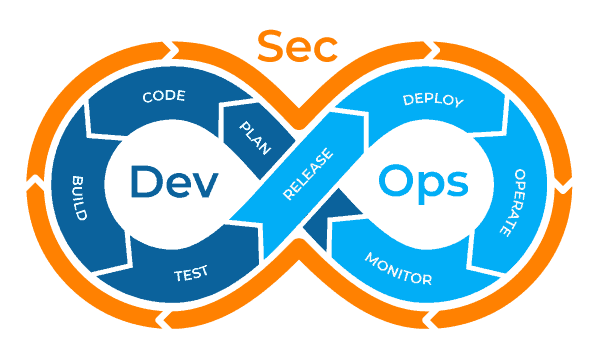
DevSecOps is the union of Development, Security, and Operations to allow security tools to be integrated into automated continuous integration and continuous deployment (CI/CD) processes.
Vulnerability Management
Generally, development teams already have issue tracking tools, however security teams need visibility and require tools that allow them to measure the status and progress of security according to organizational policies. For this reason, vulnerability management and tracking tools are used to ensure that risks are prioritized and resolved on time according to what is established by company policies or regulations.
Application Certification
Automated tools allow solving vulnerabilities in early stages, however it's usual that a final security verification is needed before a production release, commonly when it's a major version or includes large software changes. Application certification is performed through manual penetration testing (pentest) which allows detecting risks that automated tools may have missed.
The importance of "pentests" lies in the fact that automation can exclude tests that depend on context or specific knowledge of business logic. However, since it's a manual process that takes several weeks, it's usually performed once a year or when significant application changes are made.
Conclusion
Now you know the basics about what AppSec is and some of its processes. Keep in mind that the topic is constantly evolving and new techniques or technologies are being added each day that involve new security processes such as Infrastructure as Code (IaC) or serverless applications.
Application security (AppSec) in Canada
Our application security service reviews the code, dependencies and architecture of software built by Canadian product and engineering teams in banking, insurance, health technology and public-sector supply chains, most of them shipping cloud services from Ontario, Quebec and British Columbia to uncover flaws such as injections, broken authentication and data exposure, in a country where the federal PIPEDA governs personal information handled in the course of commercial activity, while organizations operating wholly within Quebec, Alberta or British Columbia fall under provincial private-sector privacy statutes declared substantially similar to it. We embed AppSec practices into every stage of the development lifecycle for organizations in Canada.
Faced with phishing and credential-reuse attacks aimed at customer-facing portals and at the third-party services wired into them, we prioritize weaknesses according to the risk they pose to users and operations, with reports ready to support PIPEDA compliance, structured so that every finding carries its evidence, its exploitation path and the fix that closes it. Development teams in Canada receive concrete remediation guidance and training to build more resilient applications by design.