ATTACKERS EVOLVE EVERY SINGLE DAY
Cybersecurity changes constantly. Every week brings new vulnerabilities, and the race to patch everything never ends for those who work in sectors as sensitive and heavily targeted as banking. But there is a problem tied to the speed of traditional consulting services.
Traditional consulting is slow
Let's be honest: we are no longer in the era when annual penetration tests were enough. If we try to force the traditional consulting model into agile environments, the result becomes a headache for you, because it turns into a bottleneck.
We have lived it ourselves, and the need to evolve pushed us out of our comfort zone to innovate and improve, because it truly becomes unmanageable. Our answer was to build an agile process that delivers manual penetration testing through an on-demand services platform.
It has not been easy at all
In fact, the most comfortable path, and the one many consulting firms take, is to justify the same old services to avoid at all costs the transition that would mean sacrificing part of their margins to share them with a third party, or building it on their own, which would be far more expensive for them.
Attackers evolve constantly. Every week there is a new ransomware variant, or new vulnerabilities are discovered, shared, and exploited among criminal groups before they ever become public.
At WhiteJaguars we spent 10 years refining the process before we could release it to the world. The reality is that there is a lot that can be automated, and we certainly did, but the manual penetration testing behind reports ready to support SOC 2 and PCI-DSS compliance cannot be fully automated. That is why the final product we built combines everything that can be accelerated through automation while also integrating manual testing performed by certified professionals.
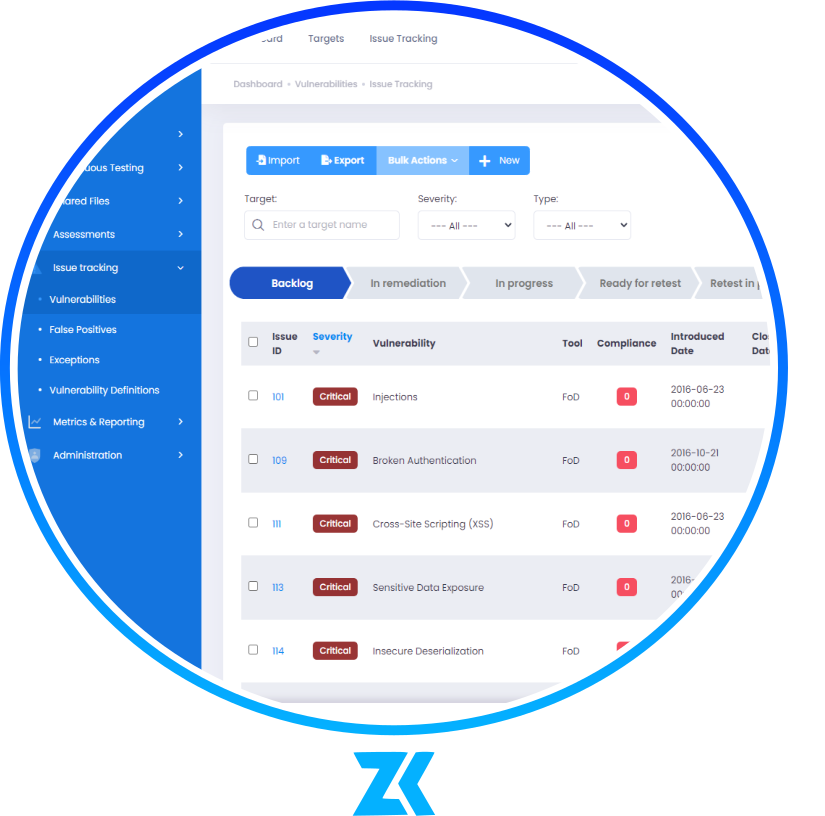
Among many other things, we solved several important challenges, such as being able to manage every vulnerability in a single place and generate reports automatically, but with findings written by us, with evidence captured manually and in our clients' language.
In the end we significantly improved the penetration testing process so it runs in a fast, optimized way. The current process does not depend on a single person to carry out each pentest from start to finish; our process is literally an assembly line that combines automated tasks with the work of a professional team in an environment orchestrated by our platform. We also built new modules to automate scan execution as part of DevSecOps processes, and we keep adding features frequently, such as continuous reviews, automated remediation policies, collaborative remediation, third-party tool integrations, and much more.
How complicated is your current workflow?
Now it is your turn to reflect on whether your current process is enough, or whether it is slow, complicated, or makes you work harder than necessary.
It may be time to discover what you have been missing, what many companies across the US, UK, Canada, and Silicon Valley are already using.